Apple Introduces PICO: AI Image Codec
Next-gen AI image compression by Apple

Perceptual Image Codec (PICO)
Apple has announced a new learned image codec that they claim is not only highly efficient but also practical for real-world use. It is primarily optimized with the human visual system in mind.
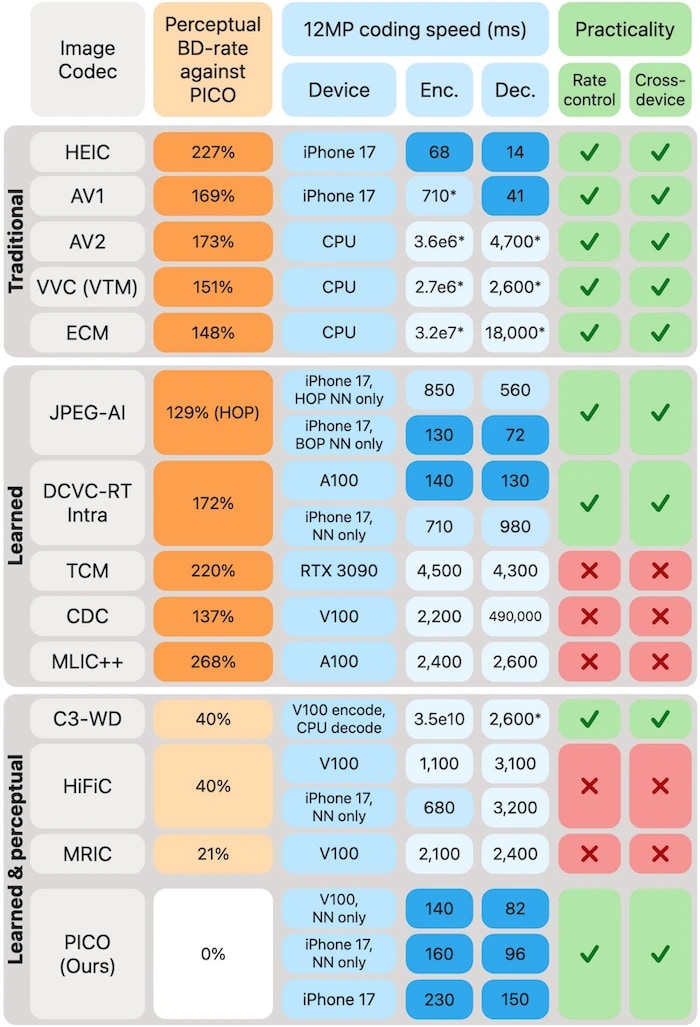
According to the analysis published on Apple’s GitHub page, PICO provides 2.3-3× bitrate savings against AV1, AV2, VVC, ECM, and JPEG-AI, along with 20-40% bitrate savings compared to the best alternative learned codecs.

PICO is a dedicated still-image codec. When compared to true image codecs like JPEG, as well as still-image formats derived from video codecs (like HEIF/HEIC, AVIF, and WebP), PICO is expected to retain higher detail at similar file sizes.
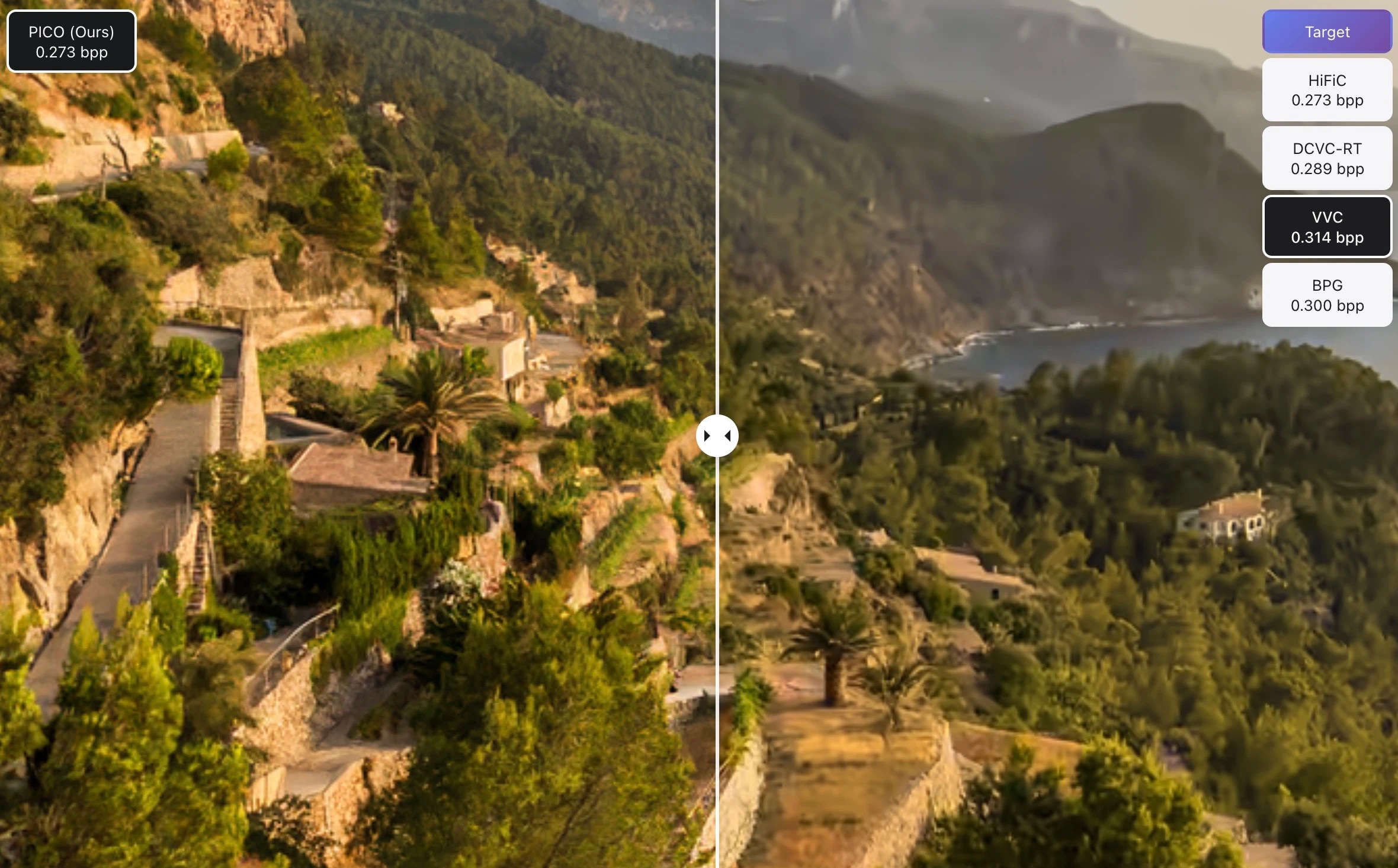
JPEG-AI has gained traction over the last few years, alongside other learned image compression techniques such as HiFiC and TCM. Apple has published a detailed comparison (pictured below) pitting PICO against these and several other codecs.
Speed
Based on the data published by Apple, processing time does not seem to be a bottleneck. On an Apple iPhone 17 Pro Max, PICO can encode and decode a 12MP image in less than 250ms—specifically, 230ms to encode and 150ms to decode. For context, a human blink takes anywhere between 100-400ms.
Quality
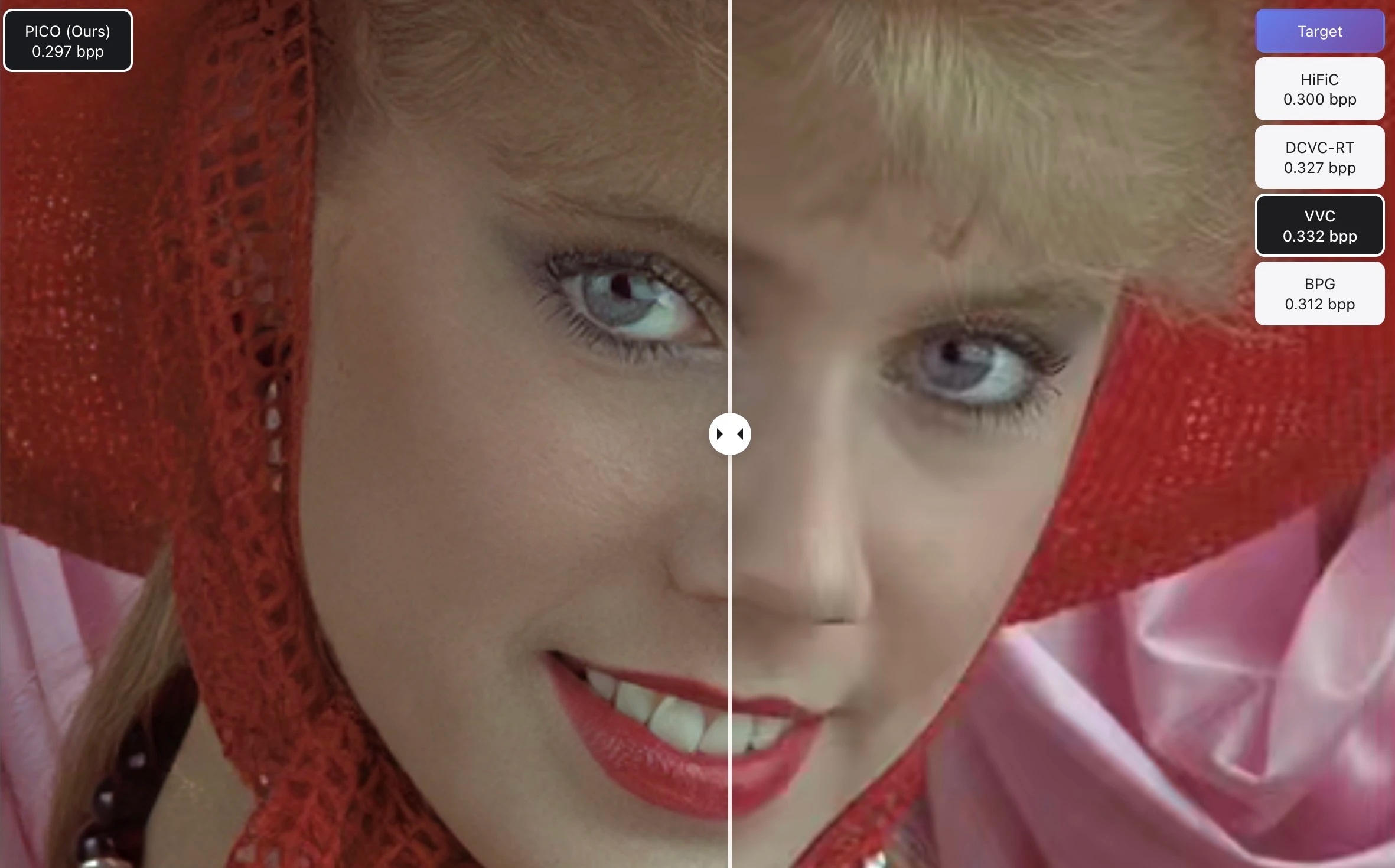
As demonstrated in the main image of this blog, the visual quality remains quite impressive even at considerably low bits-per-pixel (bpp) rates.

AI/Learned Image Codecs vs Traditional Image Codecs
Traditional image codecs have been around for decades, and with each release, we see new features and better compression techniques. So what exactly are these AI image codecs trying to solve?
Traditional image codecs rely on a static ruleset—a fixed set of mathematical formulas. In contrast, learned codecs rely on machine learning-based prediction techniques backed by the massive volumes of data they are trained on. Learned image codecs are designed to dynamically determine which data the human eye will or won’t notice, allowing them to efficiently discard unnecessary information while generating highly realistic textures during the decoding process.
Are Learned Image Codecs available for Testing?
Yes, but right now they are geared toward researchers and developers rather than end-users. Consequently, many of these codecs are not easy to set up and test locally. I will try to find my way around one of these and provide a demonstration in a future blog post.
Will this neural codec be a costly affair?
Since PICO has not seen a public release yet, its licensing and cost structure remain unknown. We will need to wait for official guidance from Apple, as the technology is currently their proprietary property.
Apple maintains the HLS streaming protocol as a royalty-free standard that can be implemented at zero cost, even though the underlying video codecs themselves may carry separate licensing fees. Similarly, the Apple Lossless Audio Codec (ALAC) was initially proprietary but was later made open-source and royalty-free. Going by this historical behavior, it is possible that Apple will establish an open standard for PICO upon its release. Only time will tell.